The Hidden Connection Between Persistent Pain and Mental Health

Crystal Garcia, PTA
Equipt Physical Therapy Assistant
Written By Crystal Garcia, PTA
I can't help but see a pattern in this population that mimics my own lived experience with chronic pain. A pattern in the way nervous systems have adapted to survive, and how at times our brains are both our best friend and greatest enemy.
After almost two decades of studying the human body, I thought I understood pain.
Then pain taught me what I was missing.
When Physical Therapy Isn't the Whole Story
In physical therapy we are trained to look for musculoskeletal sources of injury. If someone has shoulder pain, we examine the shoulder. If they have low back pain, we examine the spine. Find the damaged structure, restore movement, and the pain should improve.
However, it's not always the whole story.
In 2019 I became a patient and discovered this for myself.
It started with random chest pain at work — which turned out to be panic attacks I was ignoring really, really well.
Then my right arm began to hurt. I'd had a previous injury to my neck that explained some things… but this pain was not just an ache — it was burning after just a little use, doing things I used to easily do every day. Everything in my life seemed to trigger this pain. Eventually, it became so debilitating that it no longer felt like it belonged to me. It was attached to my body, but it didn't feel like my arm anymore. It was a pain that scans and doctors couldn't find any reason for. Even though this "educated" person sat before them, spoke their medical language, and told them of very REAL symptoms, I couldn't understand what was happening.
What Chronic Pain Taught Me About Trauma and Survival
At this point in my life I felt very out of control of my life AND body. I was eventually admitted to an inpatient mental health program where I was diagnosed with PTSD, anxiety, and depression.
One of the most surprising realizations wasn't the diagnoses themselves.
It was discovering that not everyone lives this way. I genuinely believed everyone spent days or weeks feeling emotionally numb. I used to call them my "Dead Days" because I felt like a zombie, but I was getting through just fine. Turns out being constantly abused and neglected since childhood, and witnessing constant abuse and neglect, doesn't just leave you with a desire to be covered in tattoos and a dark sense of humor… It has an impact on the way you learn to survive.
I thought everyone ran on adrenaline until they were completely out of gas, then disconnected from themselves when life became too overwhelming.
That was my normal. It's how I adapted to face the threats I grew up around.
I built a successful career. I had high-adrenaline hobbies… and maintained a social life. People saw someone who was productive, dependable, and high-achieving.
I thought feeling nothing was a human superpower.
I thought I was fine. (That this is what success should look and feel like!)
Looking back, I wasn't thriving. I was surviving.
And there's a profound difference between the two.
I was forced to reckon with the fact that maybe what I had survived throughout my entire childhood wasn't normal. And the ways I had adapted to survive then weren't serving me now.
The Turning Point: Somatic Therapy and Nervous System Regulation
But the turning point on my pain journey wasn't physical therapy or another MRI — though I did see an amazing persistent pain PT who helped me find my way back to trusting my body with movement.
It was therapy. Specifically, somatic therapy.
For the first time, I began paying attention to the relationship between my nervous system, my emotions, and my pain.
When my stress and hypervigilance increased, my pain increased.
When I felt emotionally unsafe, my body became more protective — more on high alert. Even today, I can pinpoint my back pain flaring up when I feel fearful, or powerless, or generally not in control.
When I learned how to start to feel and accept feelings of safety in my body, my pain decreased overall. And I gradually became more and more able to implement other things I knew would keep me in that state — more able to regularly exercise and do the things I needed to tackle my pain both physically and mentally.

Pain Is an Alarm System, Not Just Tissue Damage
As physical therapy professionals, we now understand much more about pain than we did twenty years ago.
Researchers and educators have helped translate pain neuroscience into clinical practice by emphasizing that pain is an output of the nervous system — a protective response — not simply a measure of tissue damage. That this protective response operates along the same part of our nervous system that controls our state of fight/flight/freeze.
We don't have pain receptors in our bodies; we have sensation receptors that our body interprets as pain.
Pain is our body's alarm system that something is wrong and needs our attention. Again, not simply a measure of tissue damage.
The brain is constantly asking one fundamental question:
"Am I safe?"
If the answer is yes, the alarm quiets. Our anticipation of pain, and perception of pain itself, decreases. Movement can become easier.
If the answer is no, the nervous system can increase protection.
That protection may include muscle guarding, heightened sensitivity, fatigue, fear of movement, and persistent pain — even when tissues have healed.
Alarm systems are generally designed to protect us.
But if your smoke detector becomes so sensitive that it goes off every time you make toast, the alarm is still real — even though there isn't a house fire. It's just not really that helpful.
Persistent pain can be like that. Constantly triggering an alarm for things that are not an emergency.
How Trauma Shapes Persistent Pain
Now let's think about that through the lens of trauma.
For many people with a trauma history, the nervous system has spent years learning that the world is unpredictable or unsafe.
Hypervigilance becomes the default, and the sympathetic nervous system stays prepared for fight or flight.
When the threat becomes overwhelming or escape feels impossible, many people shift into shutdown — what many people recognize as dissociation or freeze.
Neither state is a conscious choice.
They are adaptive survival responses.
When we consider persistent pain alongside these nervous system responses, the overlap becomes striking.
A nervous system that has learned to anticipate danger is also more likely to amplify protective outputs — including pain.
That doesn't mean trauma causes every pain condition.
It doesn't mean every person with persistent pain has a trauma history.
And it certainly doesn't mean the pain is "all in someone's head."
The pain is real. The nervous system is real. The biology is real.
The alarm just needs to re-learn how and when to be triggered — so that it is actually keeping you safe again.
Adults in custody have disproportionately high rates of childhood adversity, trauma exposure, substance use disorders, and mental illness — all factors that make our bodies' alarm system overprotective.
Many of you have lived in survival mode for years. And now you continue to live in an environment that requires this.
Some of you have never experienced what true nervous system regulation feels like.
So when someone presents with persistent pain — especially while incarcerated — we're not just evaluating muscles and joints.
We're caring for a nervous system shaped by lived experience.
Movement, Safety, and Restoring a Sense of Agency
My own experience changed the way I practice.
I still look at biomechanics. Movement remains medicine. But I also recognize that education reduces fear.
Validation reduces threat. Curiosity builds trust. Safety is therapeutic.
No one — regardless of where they come from, what they've done, what they've survived, or what abilities they have — wants to feel powerless in their own body.
Both trauma and pain have a way of taking that sense of control. It can make people afraid to move, afraid to trust their body, and afraid that every sensation means something is getting worse.
As physical therapy professionals, we are in a unique position to help restore that sense of agency.
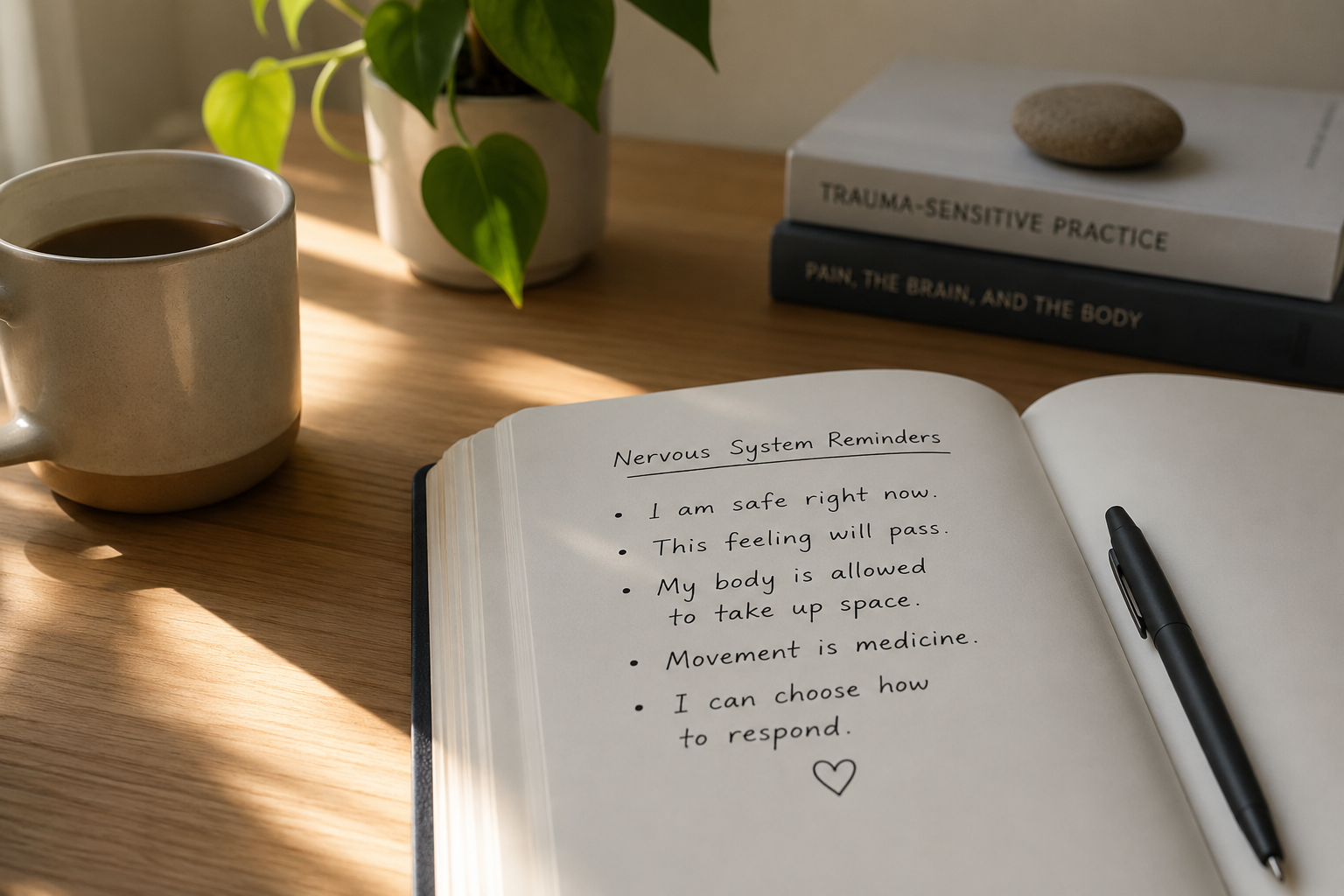
We don't just prescribe exercises. We help people reconnect with their bodies.
Movement becomes more than strengthening a muscle or increasing range of motion.
Movement can be a powerful way to regulate the nervous system. Gentle, meaningful movement provides the brain with new information. It says, "This movement is safe. My body is capable. I don't have to stay in protection all the time."
Every successful movement experience becomes evidence that the alarm system can begin to quiet.
That doesn't mean movement cures trauma.
It doesn't mean exercise alone resolves persistent pain.
But when movement is paired with education, safety, trust, and a therapeutic relationship, it can help shift the nervous system from protection toward regulation.
By helping someone rediscover that they are not trapped by their nervous system, they learn that their body is adaptable, and that improvement is possible.
Today, I spend less time asking,
"Where is the pain?"
And much more time asking,
"What has this nervous system experienced?"
Every person we meet has a nervous system that tells the story of their life.
When we understand the relationship between mental health, nervous system regulation ability, and pain, we start asking,
"What happened to this person, and what adaptations helped them survive?"
That shift doesn't just change our understanding of pain.
It changes how we care for people.
And being understood is the first step toward healing.